
24/7 Emergency Service in Summit County
Sump Pump Repair in Akron, OH
Rubber-Boom Housing, Valley Ground, Combined Sewers
Akron’s basements were dug for a rubber boom a century ago, in a river valley, on a sewer system that still mixes storm water with sewage in places. We find the actual fault before anyone talks about a new pump.
Answered 24 hours. Free quote over the phone.
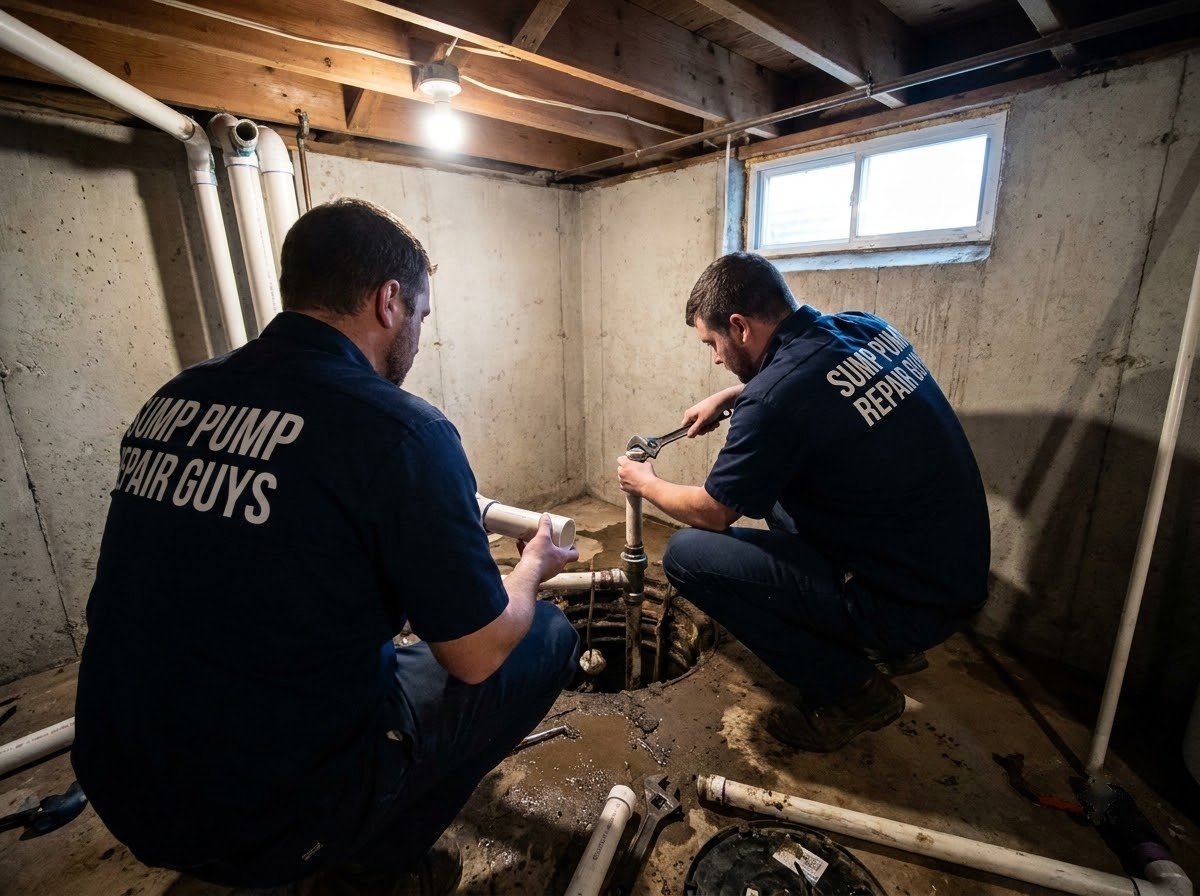
About Sump Pump Repair Guys in Akron
We repair sump pumps. That is the entire business, and in Akron it matters more than it sounds, because the companies competing for this work are waterproofing contractors and full-service plumbers who sell systems. Their incentive is the bigger job. Ours is finding out which part failed.
Akron gives a pump an unusually hard life. The city grew fast during the rubber boom, which means a deep stock of houses built between roughly 1900 and 1930, with basements that predate the idea of a sump system entirely. Most pits here were cut in decades later, smaller and shallower than they should be, and an undersized basin is the single most reliable way to destroy a float switch.
The ground does not help. Akron sits in and around the Cuyahoga River valley and the old Ohio and Erie Canal corridor, on glacial till with slopes running down toward the water. Runoff arrives with speed on the valley sides, and the flatter ground near the river holds a genuinely high water table year round.
Then there is the sewer. Akron still operates 34 combined sewer overflow outfalls, where storm water and sanitary sewage share one pipe. Those outfalls exist specifically to relieve pressure and prevent backups at storm drains and in basements. When relief cannot keep up, the pressure looks for the next opening, and that is frequently a basement floor drain. It is not a pump fault, and no pump you can buy will fix it.
So our first job on an Akron call is not the pump at all. It is working out where the water actually came from.
- Relief points in Akron’s collection system that exist to prevent backups at storm drains and in basements during heavy rain.
- Akron Waterways Renewed! is a federal consent decree programme. The work is far along but not finished.
- What the Ohio Canal Interceptor Tunnel keeps out of local waterways in a typical year since going into service.
- You approve the number first. No surprise line items when the invoice arrives.
- We fill the pit and watch a full cycle: activation, run, shutoff, and any backflow through the valve.
34 combined sewer outfalls
24 of 26 consent decree projects done
467 million gallons held back a year
Priced before we start
Tested before we leave
Sump pump repair services in Akron
Sump pump repairs we handle in Akron
Most Akron sump pump problems are component faults. We work on the whole system so the repair holds: the pit, the switch, the valve, the motor and the line that carries the water away.
- 01
Sump pump diagnostics
A manual lift test separates a switch failure from a motor failure in under a minute. We identify the exact fault and its price before quoting anything, so you are not paying replacement rates for a parts-level problem.
- 02
Water source diagnosis
Pit, floor drain or window well. In a city with 34 combined sewer outfalls this is the question that decides everything, and it is the one most contractors skip straight past.
- 03
Float switch repair and adjustment
The most common failure point on any pump. We free jammed floats, replace failed switches, and set trip heights so the on and off points do not overlap and start the pump short-cycling.
- 04
Check valve replacement
A failed valve lets the discharge column fall straight back into the pit. On the valley slopes, where the pump is already lifting water a long way, that wasted work shortens the motor’s life fast.
- 05
Motor repair
Humming with no flow, tripped thermal overloads, failing bearings. We test the motor under load and tell you honestly whether a repair is worth it or whether the unit has been shortened past the point of value.
- 06
Impeller repair
Grinding and rattling usually mean debris in the vortex impeller or clearances worn open by grit. Valley runoff carries sediment straight into the basin, so this is common here.
- 07
Frozen discharge line repair
Northeast Ohio winters ice a badly pitched line solid. We thaw and clear it, then correct the pitch and termination so it drains fully between cycles instead of freezing again next month.
- 08
Sump pit cleaning
Silt and iron ochre settle in the basin, block the intake screen and grind through the switch. Sediment is the single biggest lifespan killer in a Summit County sump system.
- 09
Pit and basin repair
Rubber-era houses have pits retrofitted long after construction, frequently undersized. A small basin makes the pump short-cycle and destroy its own switch, whatever brand goes in the hole.
- 10
Discharge line repair and rerouting
Blocked, crushed, or terminating where gravity carries the water straight back to your own foundation. On a slope, placement matters as much as the pump does.
- 11
Backup system service
Deep cycle batteries lose capacity quietly over three to five years and fail during the outage they were bought for. We load test the battery, service the backup pump and confirm the changeover triggers.
- 12
Emergency service
Water already on the floor, alarm sounding, pump silent. Same day and after hours response across Akron. We get the system back in service first and have the longer conversation afterwards.
Why Akron homeowners call us first
We work on sump pumps and nothing else. That is not a slogan, it changes what happens when a technician looks in your pit.
-
We will tell you it is not the pump
With 34 combined sewer outfalls still in the system, a real share of Akron basement water is surcharge coming up the floor drain. We say so instead of quoting a pump that cannot help.
-
We size for the valley
A slope lot means real vertical lift plus friction from a long run. Every ten feet of horizontal pipe adds roughly a foot of effective lift. Pumps specified on horsepower alone underperform badly here.
-
Answered at 2am
Pumps fail during storms, at night, and while you are away. Our lines stay open all night and all weekend, and someone picks up. Basements do not flood during business hours.
-
Priced before we start
You get a written number after the diagnosis and approve it before any work begins. No surprise line items when the invoice arrives.
-
Licensed and insured
Every technician who enters your home is properly licensed, insured and background checked. You can ask for the paperwork at the door.
-
We stand behind it
If the same fault comes back after we have worked on it, we come back and sort it out.
When to call a sump pump technician in Akron
Sump pumps rarely fail without warning. Several of these are parts-level repairs, and two are not a pump problem at all.
-
01
Silent pump, rising pit
Call now
Check the breaker and the plug first, then lift the float by hand. If it runs, the switch is the fault and not the motor. Near the valley floor the basin refills fast, so this one does not wait until morning.
-
02
Water rose at the floor drain, then drained away
Sewer, not pump
Rapid rise during the storm followed by a fairly quick retreat is the signature of a combined sewer surcharge, not a pump failure. Akron still has 34 CSO outfalls. Report it to the city, photograph everything, and keep the record before anyone sells you equipment.
-
03
High water alarm sounding
Call now
Inflow has overtaken output, which means something upstream already failed: the switch, the valve, the discharge line or the pump. The alarm is the last warning before water reaches the floor, and silencing it buys you nothing.
-
04
Running non-stop after every rain
On a valley slope this can be correct behaviour, because your pit is taking runoff from everything uphill. The question is whether it stops within a reasonable time. If it never stops even in dry weather, suspect a stuck float or a failed check valve first.
-
05
Cycling on and off every few seconds
Short-cycling, and in Akron’s rubber-era housing a retrofitted basin too small for the inflow is the usual cause, alongside a failed check valve or trip points set so close they overlap. A bigger pump makes this worse, not better.
-
06
Humming with no water moving
Jammed impeller, seized bearings, or a completely blocked or frozen discharge line. Switch it off now. Clearing the impeller or the line is often a same-visit fix, but another hour of humming turns it into a replacement.
-
07
The discharge line is frozen
Unplug the pump. It is pushing against a solid plug of ice and will trip the thermal cutout or burn out. Thawing alone is not the fix, because the pitch that let water sit in the line will freeze it again next month.
-
08
Your backup has never been load tested
Northeast Ohio storm outages and peak pump demand arrive in the same hour. A battery that tested fine two seasons ago may have almost nothing left. If you have never load tested yours, you do not currently know whether you have a backup.
-
09
The pump is over seven years old
Most sump pumps last seven to ten years, and a pump lifting water up a valley slope works harder than that rating assumes. Replace at that age or when a repair estimate reaches about half the cost of a new unit installed.
How an Akron service call runs
Five steps, the same every time. No sales visit, no waiting days for a number.
- 1
Find the water source first
Pit, floor drain or window well. In a city with 34 combined sewer outfalls those are three different problems, and only one of them is a pump.
- 2
Check the setup
Pit, pump, float switch, check valve and discharge line, including how far the discharge lifts and where it terminates on the slope.
- 3
Test under water
We fill the basin and watch a real cycle: activation height, run, shutoff, and whether anything comes back through the valve.
- 4
Price it, then repair
Written number before anything is touched. If the answer is that you need the city rather than us, we say that instead and you pay nothing.
- 5
Test again and hand it over
Final full-cycle test, then we show you how to check it yourself and what to watch for before the next heavy storm.
Akron ground conditions
Why an Akron pump ages faster than the label says
Three local conditions stack on top of each other, and all three land on the same piece of equipment.
-
Housing
Basements built before sump pumps existed
Akron’s population exploded during the rubber boom, leaving a deep stock of homes from roughly 1900 to 1930. Those basements were never designed around a pit. Most Akron pits were cut in decades later, and a retrofitted basin is usually smaller and shallower than the inflow deserves. That is the root cause of the short-cycling we see across the city.
-
Terrain
Valley slopes and the canal corridor
Akron sits around the Cuyahoga River valley and the old Ohio and Erie Canal corridor. On the valley sides, runoff arrives fast and your pit handles water from everything uphill. On the flatter ground near the river and through Cascade Valley, the water table is genuinely high most of the year.
-
Sewers
34 combined sewer outfalls, still in service
In a combined system, storm water and sanitary sewage share one pipe to the Water Reclamation Facility. During rain the pipes fill, and CSO outfalls release the excess to nearby water bodies specifically to prevent backups at storm drains and in basements. When that relief cannot keep pace, pressure finds the next opening, and often that is your floor drain.
-
Progress
Akron Waterways Renewed! is nearly done, not done
The city has completed 24 of 26 projects under its federal consent decree with the Ohio EPA and US EPA. The Ohio Canal Interceptor Tunnel, 27 feet across and 6,240 feet long, stores up to 25.6 million gallons per storm and keeps roughly 467 million gallons a year out of local waterways. The Northside Interceptor Tunnel is still under construction.
-
What it means
Better is not the same as solved
Those tunnels have measurably reduced overflow events, and that is real. But relief capacity is sized for typical storms, and a heavy one still finds the limit. If your basement flooded once through the drain, treat a working check valve and backflow protection as non-negotiable rather than optional.
-
Winter
The discharge line nobody inspects
Northeast Ohio runs a long freeze. A discharge line that does not drain fully between cycles ices into a solid plug, and the pump then runs against a closed pipe until the thermal overload trips. The fault surfaces at the thaw, exactly when the pit needs the pump most.
Areas we cover in Akron
Neighbourhood tells us a lot before we arrive. The older streets through North Hill, Goodyear Heights and Kenmore carry rubber-era basements with retrofitted pits. Highland Square, West Hill and Merriman Valley sit on slopes where discharge lift and runoff volume dominate. Downtown and the Cascade Valley corridor are where combined sewer relief matters most.
- Highland Square
- West Hill
- North Hill
- Goodyear Heights
- Firestone Park
- Kenmore
- Merriman Valley
- Wallhaven
- Ellet
- Firestone Hills
- Downtown Akron
- University Park
- Middlebury
- Sherbondy Hill
- Lane-Wooster
- Summit Lake
- Chapel Hill
- Rolling Acres
- Cuyahoga Falls
- Stow
- Barberton
- Green
ZIP codes we service in Akron
Same-day coverage across the city and the surrounding Summit County suburbs.
- 44301
- 44302
- 44303
- 44304
- 44305
- 44306
- 44307
- 44308
- 44310
- 44311
- 44312
- 44313
- 44314
- 44319
- 44320
- 44321
- 44333
- 44203
- 44221
- 44223
- 44224
- 44685
Not listed? We cover all of Summit County. Call and we will confirm in under a minute.
Rules that apply to your discharge
What Ohio and Akron require of a sump pump
Almost nobody reads this, and almost no contractor raises it. These are the standards that decide whether your installation is correct or merely working for now.
-
Ohio Plumbing Code
Sumps connect indirectly
Under the state plumbing code, sumps and sump pumps are permitted at the base of a shaft only where they are indirectly connected to the plumbing system. Direct connections into sanitary drainage are exactly what overloads mains during storms and pushes water back into basements.
-
Consent decree
Inflow is the problem being engineered out
Akron Waterways Renewed! exists because storm water reaching the sanitary system causes overflows. Feeding your sump or downspouts into a sanitary connection works against the same system that is supposed to protect your basement.
-
Property line
Where the water is allowed to go
Discharge should terminate well clear of your own foundation, and it must not be dumped onto a neighbouring property or into the public right-of-way. On a valley slope that takes planning, because gravity will happily carry it back to the lowest point, which is often your own wall.
-
Backflow
A check valve is protection, not an accessory
In combined sewer districts a working check valve and backflow protection are the difference between a wet week and a ruined basement. If yours has never been tested under load, assume it needs checking before the next heavy storm.
-
Your lateral
The private side is yours
The line from your house to the public main is the property owner’s responsibility. A blocked private lateral is not a city problem and is not covered by anyone else, which is why a backup needs the source identified before you decide who to call.
-
Documentation
Record every event
If water came up the drain, photograph it, note the date and the rainfall, and report it. Akron publishes overflow status information, and a documented pattern is worth far more than a memory when you are arguing about cause.
Akron sump pump questions, answered
The things Summit County homeowners ask us most often, answered properly instead of with a sales line. If yours is not here, give us a call and we will talk it through.
Water came up my floor drain. Do I need a new sump pump?
Almost certainly not. Akron still operates 34 combined sewer overflow outfalls, where storm water and sanitary sewage share a single pipe. During heavy rain those pipes fill and pressure can push water back up the lowest drain in your basement. Your sump pump does not serve that pipe at all.
The tell is timing. Sewer surcharge rises fast during the storm and retreats fairly quickly afterwards. Groundwater seeps in slowly and lingers. Photograph it, note the date and rainfall, and report it before anyone sells you equipment.
Has the tunnel project fixed Akron’s basement flooding?
It has helped a great deal, and the numbers are real. The Ohio Canal Interceptor Tunnel stores up to 25.6 million gallons per storm and keeps roughly 467 million gallons of combined flow out of local waterways in a typical year. The city has completed 24 of 26 consent decree projects, with the Northside Interceptor Tunnel still under construction.
But relief capacity is sized for typical storms, not every storm. Better is not the same as solved. If your basement has flooded through the drain once, treat backflow protection as necessary rather than optional.
Why does my pump short-cycle in an older Akron house?
Because the pit was almost certainly cut in long after the house was built. Akron’s rubber-boom housing stock predates sump systems, and retrofitted basins are frequently smaller and shallower than the inflow deserves. The pump empties it faster than it refills, restarts within seconds, and destroys its own switch.
The other two causes are a failed check valve letting the discharge column fall back in, and float trip points set so close that the on and off heights overlap. All three are fixable. None of them is fixed by a bigger pump.
Do I need a bigger pump if mine cannot keep up?
Usually not. A pump that cannot keep up is often fighting a failed check valve, a blocked or frozen discharge line, a basin too small for the inflow, or a sewer surcharge that is not the pump’s job at all.
Where sizing genuinely matters in Akron is lift. A valley slope adds real vertical height plus friction, roughly one extra foot of effective lift for every ten feet of horizontal run. Pumps specified on horsepower alone without counting that run underperform badly.
My discharge line froze. What should I do?
Unplug the pump first. It is pushing against a solid plug of ice and will trip its thermal cutout, or burn out if the cutout has already failed.
Thawing is not the fix, because the same pitch that let water stand in the line will freeze it again next month. The correction is drainage between cycles, a larger diameter section above grade, and a termination point where meltwater does not pool and refreeze.
How do I test my sump pump myself?
Pour several gallons of water slowly into the basin and watch a full cycle. The float should rise, the pump should start, the water should clear, and the pump should shut off on its own.
Then keep watching for thirty seconds. Water flowing back into the pit means the check valve is failing. If the pump does not start at all, lift the float by hand: if it runs then, the switch is the problem, not the motor. Test in autumn before the freeze and again in early spring.
Should I repair or replace?
Replace when the pump is past seven to ten years old, or when the repair estimate reaches about half the cost of a new unit installed. Below that line, repair usually wins.
A four year old cast iron pump with a dead float switch is worth repairing. A nine year old thermoplastic pump with a seized impeller is not. On a high-lift valley installation, assume the pump has worked harder than its age suggests.
Does homeowners insurance cover a flooded basement in Akron?
Usually not by default. Standard policies generally exclude groundwater intrusion and flooding caused by sump pump failure, and coverage for that event is sold as a separate rider or endorsement.
Sewer backup is often a separate endorsement again, which matters here given how much of the older city still sits on combined sewers. Check both before you need them rather than during a claim.
How often should the pit be cleaned?
Once a year, and more often on a slope, because valley runoff carries silt and grit straight into the basin. Sediment grinds mechanical switches, jams impellers and narrows the float travel path until the switch stops working reliably.
Cleaning a basin is one of the cheapest things you can do for a sump system. Replacing a pump that died from grit is not.
Which Akron areas and ZIP codes do you cover?
All of Akron and the surrounding Summit County area, including Highland Square, West Hill, North Hill, Goodyear Heights, Firestone Park, Kenmore, Merriman Valley, Wallhaven, Ellet, Downtown, University Park, Middlebury and Summit Lake, plus Cuyahoga Falls, Stow, Barberton and Green.
ZIP codes include 44301, 44302, 44303, 44304, 44305, 44306, 44307, 44308, 44310, 44311, 44312, 44313, 44314, 44319, 44320, 44321 and 44333, along with 44203, 44221, 44223, 44224 and 44685 in the surrounding suburbs.
How quickly can someone come out?
Same day across most of Akron, and after hours for emergencies where water is already coming in. Diagnosis takes thirty to sixty minutes, and a parts-level repair such as a float switch or check valve is generally completed in the same visit.
Heavy storm events are the exception, when calls across the county spike within the same hour. An inspection booked outside storm season is worth far more than a place in that queue.
Find out whether it is your pump before you pay for one.
Emergency repair, water source diagnosis, discharge and lift checks, or a full-system inspection before the freeze. Serving Akron and all of Summit County.