
24/7 Emergency Service in Lucas County
Sump Pump Repair in Toledo, OH
Built on a Drained Swamp. Your Pump Knows It.
Toledo sits on the old Great Black Swamp: flat, low, and layered in clay that will not let water go anywhere. Pumps here run more hours a year than almost anywhere in Ohio. We repair the fault instead of selling you a new one.
Answered 24 hours. Free quote over the phone.
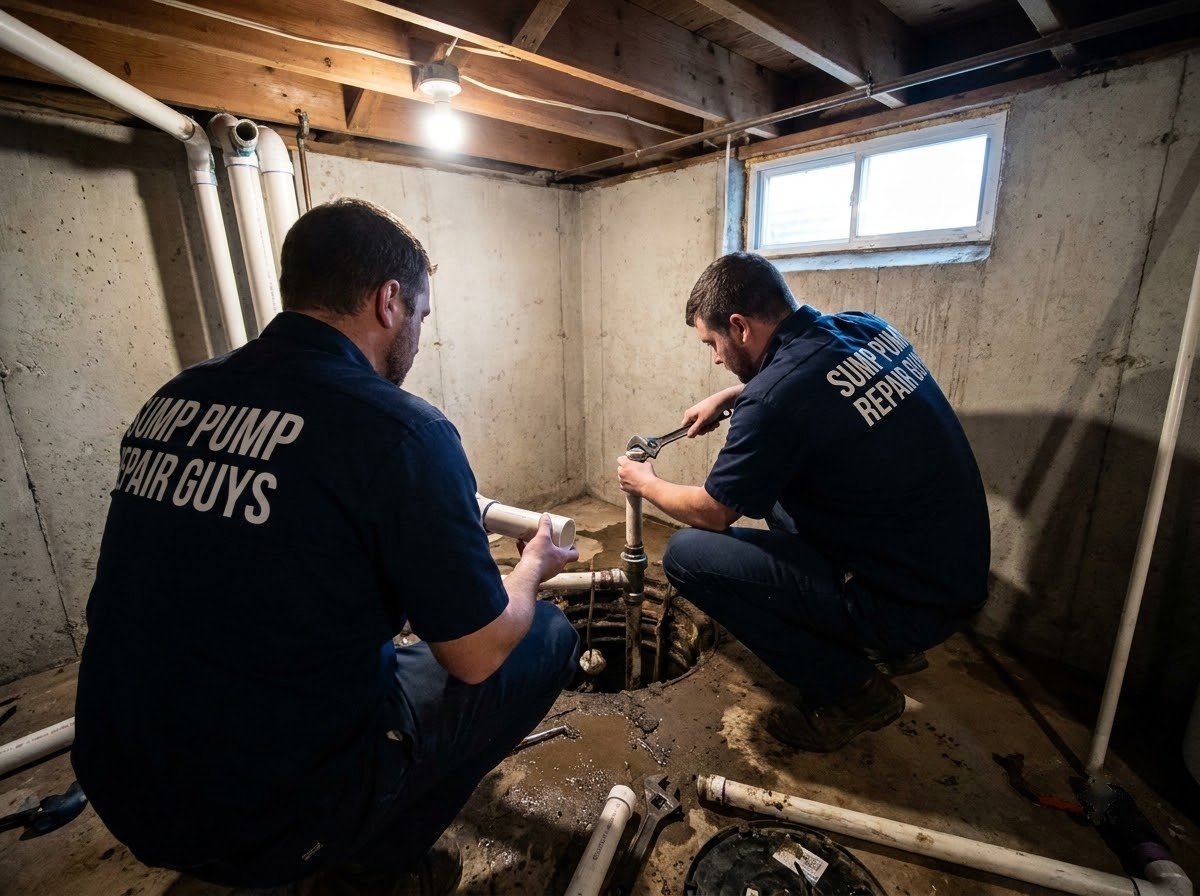
About Sump Pump Repair Guys in Toledo
We repair sump pumps. That is the entire business, and it is the reason we behave differently once we are standing over your pit.
Most companies that show up for a wet Toledo basement are full-service plumbers or basement waterproofing firms. Sump pumps are one line on a long menu, and the money is in the bigger job. So the default answer becomes a new pump, or a full interior drainage system, whether or not that is what failed.
Our default answer is a diagnosis. A stuck float, a failed check valve, a jammed impeller and a burned-out motor are four different problems with four different prices, and three of them are parts-level repairs. You get told which one you have, what it costs, and why, before anyone touches anything.
Our technicians are licensed, insured and background checked, the line is answered around the clock, and every job finishes with a full-cycle test you can watch. If the same fault returns after we have worked on it, we come back.
- No upsell into waterproofing systems, because we do not sell them.
- A stuck float or a failed check valve is a parts-level fix. We tell you which one you actually have.
- You approve the written number first. No surprise line items when the invoice arrives.
- We fill the pit and watch a full cycle: activation, run, shutoff, and any backflow through the valve.
- Toledo proper plus Oregon, Sylvania, Maumee, Perrysburg and Holland.
Sump pumps only
Diagnosis before replacement
Priced before we start
Tested before we leave
Serving all of Lucas County
Sump pump repair services in Toledo
Sump pump repairs we handle in Toledo
Most sump pump problems are component faults. We work on the whole system so the repair holds: the pit, the switch, the valve, the motor and the line that carries the water away.
- 01
Sump pump diagnostics
A manual lift test separates a switch failure from a motor failure in under a minute. We identify the exact fault and its price before quoting anything, so you are not paying replacement rates for a parts-level problem.
- 02
Float switch repair and adjustment
The most common failure point on any pump. We free jammed floats, replace failed switches, and set trip heights so the on and off points do not overlap and start the pump short-cycling.
- 03
Check valve replacement
A failed valve lets the discharge column fall straight back into the pit. On a Toledo water table where the pump is already working most of the year, that wasted cycle shortens the motor’s life fast.
- 04
Motor repair
Humming with no flow, tripped thermal overloads, failing bearings. We test the motor under load and tell you honestly whether a repair is worth it or whether the unit has been shortened past the point of value.
- 05
Impeller repair
Grinding and rattling usually mean debris in the vortex impeller or clearances worn open by grit. Lacustrine clay silt gets into the basin easily here, so this is common.
- 06
Discharge line repair and repitching
On flat ground a line that does not drain fully between cycles holds water and freezes solid. We clear it, correct the pitch and move the termination point so the water actually leaves.
- 07
Sump pit cleaning
Silt, grit and iron ochre settle in the basin, block the intake screen and grind through the switch. Sediment is the single biggest lifespan killer in a Lucas County sump system.
- 08
Pit and basin repair
Older Toledo homes frequently have pits retrofitted long after the house was built, and undersized. A small basin makes the pump short-cycle and destroy its own switch.
- 09
Backwater and check valve work for sewer backup
Isolating and elevating the basement sewer connection, standpipes and backwater valves. This is also the work the city grant covers, so we itemise it properly.
- 10
Backup system service
Deep cycle batteries lose capacity quietly over three to five years and fail during the outage they were bought for. We load test the battery, service the backup pump and confirm the changeover triggers.
- 11
High water alarm service
An alarm that never sounds is worse than no alarm, because you are relying on it. We test the sensor, the sounder and the trigger height, and replace units that have corroded in the pit.
- 12
Emergency service
Water already on the floor, alarm sounding, pump silent. Same day and after hours response across Toledo. We get the system back in service first and have the longer conversation afterwards.
Why Toledo homeowners call us first
Toledo has no shortage of companies who will sell you a bigger pump. Very few will tell you that the pump was never the problem.
-
We repair before we replace
Three of the four most common faults are parts-level fixes. We find which one you have instead of defaulting to a new pump, because replacement is not our product.
-
We will not oversize your pump
The most expensive mistake sold in this city. A big pump in a small basin short-cycles and destroys its own switch. We size to measured inflow and total lift, not to horsepower.
-
We write the quote your grant needs
Toledo’s Basement Flooding Grant application requires two written quotes. We itemise eligible work properly, whether or not you book the job with us.
-
Answered at 2am
Pumps fail during storms, at night, and while you are away. Our lines stay open all night and all weekend, and someone picks up. Basements do not flood during business hours.
-
Licensed and insured
Every technician who enters your home is properly licensed, insured and background checked. You can ask for the paperwork at the door.
-
We stand behind it
If the same fault comes back after we have worked on it, we come back and sort it out. Every job ends with a full-cycle test you can watch.
When to call a sump pump technician in Toledo
Sump pumps rarely fail without warning. On a high water table the warnings come faster and matter more.
-
01
Silent pump, rising pit
Call now
Check the breaker and the plug first, then lift the float by hand. If it runs, the switch is the fault and not the motor. On a Toledo water table the basin refills fast, so this one does not wait until morning.
-
02
Sewage came up a basement drain
Report it first
That is a sanitary backup, not a pump failure. Report it to Engage Toledo before you clean up, because verification of a public backup is what unlocks the city grant. Then call us about prevention work.
-
03
High water alarm sounding
Call now
Inflow has overtaken output, which means something upstream already failed: the switch, the valve, the discharge line or the pump. The alarm is the last warning before water reaches the floor.
-
04
Running non-stop in dry weather
In Toledo the boring answer is often correct: the water table genuinely is high. But rule out the two cheap causes first, a float stuck raised and a failed check valve refilling the pit from the discharge column. Only one of the three means you need a different pump.
-
05
Cycling on and off every few seconds
Short-cycling, and here it is usually an oversized pump in an undersized basin. It destroys switches and bearings quickly. Fitting an even bigger pump makes it worse, because it empties the pit faster still.
-
06
Humming with no water moving
Jammed impeller, seized bearings, or a completely blocked or frozen discharge line. Switch it off now. Clearing it is often a same-visit fix, but another hour of humming turns it into a replacement.
-
07
The discharge line holds water
On flat ground a line without proper pitch never drains fully between cycles. In winter that standing water freezes into a plug and the pump runs against a closed pipe until the thermal overload trips.
-
08
Your backup has never been load tested
Extreme rain events and power cuts arrive together. A battery that tested fine two seasons ago may have almost nothing left. A voltage reading is not a load test and will happily tell you a dead battery is fine.
-
09
The pump is over seven years old
Most pumps last seven to ten years, and a Toledo duty cycle sits at the demanding end of that. Replace on your schedule rather than during a storm at emergency rates.
How a Toledo service call runs
Five steps, the same on every Toledo job. No sales visit, no waiting days for a number.
- 1
Find where the water came from
Groundwater through the pit, sanitary backup at a drain, or surface water at a window well. Three different problems, and only one of them is ours. We establish that first.
- 2
Check the setup
Pit, pump, float switch, check valve and discharge line, including whether the basin was ever sized for the house and where the line actually terminates.
- 3
Test under water
We fill the basin and watch a real cycle: activation height, run, shutoff, and whether anything comes back through the valve.
- 4
Quote, then repair
Written, itemised number before anything is touched. If the work is grant eligible we write it so the application will accept it.
- 5
Test again and hand it over
Final full-cycle test, then we show you how to check it yourself and what to watch for before the next wet spell.
Local ground conditions
The ground under Toledo was never meant to hold houses
Until the late 1800s, northwest Ohio was the Great Black Swamp: a shallow, forested wetland left behind by glacial Lake Maumee. It was drained with ditches and clay tile so the land could be farmed and built on. The water did not leave. It was redirected.
That history is still in your basement. Toledo sits low in the southwestern crook of Lake Erie, straddling the Maumee River, threaded with creeks, tributaries and drainage ditches all running toward the lake. The elevation is flat, the soil is layered lacustrine clay, and the water table sits high enough that a pit can refill on a dry week. A sump pump here is not standby equipment for storms. It is a working appliance.
-
$527M
Toledo Waterways Initiative
Twenty years, more than 45 projects across 48 square miles, approved by voters in 2002 and deemed compliant with the EPA agreement in 2022. It reduced overflow into the Maumee and Lake Erie. It did not lower your water table.
-
Flat
Nowhere for water to run
On a hillside city, gravity helps. In Toledo it does nothing. Discharge placement and line pitch matter more here than horsepower, and a badly placed outlet sends the same water straight back to your foundation.
-
Clay
Layered lacustrine soil
Lake-bed clay does not drain. Rain saturates the top layer, sits against the foundation and builds hydrostatic pressure, which is why pits here refill during dry weeks and pumps run year round.
Money most Toledo homeowners never claim
The city may pay for your check valve or sump pump
If water in your basement came from a sanitary sewer backup off an overloaded main, the City of Toledo runs a Basement Flooding Grant Program that reimburses work done to stop it happening again. It is a grant, not a loan, and it is not repaid in any way. There is no age or income requirement to qualify, although those factors can affect the amount.
| What the grant covers | What it does not cover |
|---|---|
| Backwater check valves | Insurance deductibles |
| Standpipes | Replacement of damaged property |
| Sump pumps installed to stop backup | Cleanup costs |
| Sewer and plumbing modifications | Wall waterproofing and footer drain work |
| Isolating and elevating the basement sewer connection | Sewer lateral repair or cleaning, and landscaping to divert surface water |
| How the money works | Amount |
|---|---|
| First tier of eligible work | First $1,000 covered by the City |
| Second tier | Next $1,000 matched 50/50 |
| Standard maximum | $1,500 |
| Homestead Exempt or Home Energy Assistance recipients | $2,000 |
Two conditions matter. The City must verify a public sanitary backup, so report the flooding to Engage Toledo when it happens rather than after you have cleaned up. And the application needs a minimum of two written quotes, which means you should be getting a second number anyway. We will give you a written, itemised quote suitable for the application whether or not you use us for the work.
Sizing and pricing, published
Toledo is the city where sizing is most often got wrong, in both directions. Undersized pumps run continuously and burn out. Oversized pumps in a small basin short-cycle and destroy their own switch.
| Pump | Output at 10 ft of lift | Where it fits in Toledo |
|---|---|---|
| 1/4 HP | Around 1,400 GPH | Rarely enough here. Crawl spaces and low-inflow pits only. |
| 1/3 HP | Around 2,200 to 2,400 GPH | The workhorse for a standard Toledo basement on a normal water table. |
| 1/2 HP | Around 3,000 to 4,300 GPH | Heavy inflow, deep pits, long discharge runs, or a lot close to a ditch or creek. |
| 3/4 HP and up | 4,000 GPH and above | Persistent high water table or a very long lateral. Only after the inflow is measured. |
Figures come from published manufacturer performance curves and vary by model. On flat ground a long horizontal run is common, and every ten feet of it adds roughly one foot of effective lift the pump has to overcome.
| Job | Typical range, installed |
|---|---|
| Float switch replacement | Parts-level repair, well below a replacement |
| Check valve replacement | Parts-level repair, one of the cheapest fixes available |
| Pump replacement in an existing pit | $650 to $1,200 |
| Pedestal pump replacement | $400 to $900 |
| Replacement with discharge or electrical work | $1,500 to $3,000 |
| Complete new system with pit excavation | $1,500 to $3,500 |
| Battery backup system | $600 to $2,000 |
| Water-powered backup | $300 to $1,000 |
| Annual maintenance | $100 to $250 |
National published averages for 2026, so you can sanity check any quote you are given, including ours. Adding a new pit typically adds $500 to $1,000. If the work is to stop a verified sanitary backup, the city grant above may cover a meaningful share of it.
The Toledo sump pump service record
On a high water table your pump does more work per year than the manufacturer assumed. This is the maintenance schedule that actually matches the conditions here.
- Every 3 months
Run a bucket test
Pour several gallons slowly into the basin. Float rises, pump starts, water clears, pump stops on its own. Four times a year is not excessive here.
- Every 3 months
Watch for backflow
After the pump shuts off, watch the pit for thirty seconds. Water returning means the check valve is failing. Cheapest fault on this list to fix.
- Every 6 months
Check the float travel path
Look for the power cord, the discharge pipe or debris sitting where the float needs to swing. A jammed float is the most common failure and costs nothing to prevent.
- Every 6 months
Clear the intake screen
Silt and grit block the screen and then get pulled through the impeller. Two minutes with a gloved hand, power off at the breaker.
- Annually
Clean the basin
Sediment is the biggest lifespan killer in a sump system. In lacustrine clay country the basin silts up faster than most homeowners expect.
- Annually
Load test the backup battery
Deep cycle batteries lose capacity quietly over three to five years. A voltage reading is not a load test and will happily tell you a dead battery is fine.
- Before winter
Walk the discharge line
Confirm it drains fully between cycles, is pitched correctly, and terminates far enough from the foundation. On flat ground this is the difference between water leaving and water returning.
- Before winter
Test the high water alarm
Lift the sensor by hand and confirm it sounds. An alarm you are relying on that has quietly corroded is worse than having none at all.
- At 7 years
Start planning the replacement
Most pumps last seven to ten years, and a Toledo duty cycle is at the demanding end. Replace on your schedule, not during a storm at emergency rates.
- After any backup
Report it before you clean up
If sanitary sewage came up a drain, report it to Engage Toledo. Verification of a public backup is what unlocks the city grant, and it is hard to verify once the basement is dry.
Areas we cover in Toledo
Older near-downtown housing north of the river tends to have retrofitted, undersized pits where short-cycling is the standard fault. Post-war West Toledo and Point Place have correctly sized original pumps now reaching end of life together. Anywhere close to the Maumee, Swan Creek or the drainage ditches carries a genuinely high water table year round.
- Downtown
- Old West End
- West Toledo
- South Toledo
- East Toledo
- North Toledo
- Point Place
- Ottawa Hills
- Beverly
- Reynolds Corners
- Dorr Street
- Birmingham
- Swan Creek
- Oregon
- Sylvania
- Maumee
- Perrysburg
- Holland
ZIP codes we service
Same-day coverage across the city and the surrounding Lucas County suburbs.
- 43604
- 43605
- 43606
- 43607
- 43608
- 43609
- 43610
- 43611
- 43612
- 43613
- 43614
- 43615
- 43616
- 43617
- 43620
- 43623
- 43528
- 43537
- 43551
- 43560
Not listed? We cover all of Lucas County. Call and we will confirm in under a minute.
Toledo rules that apply to your pump
What the city actually requires of a sump pump discharge
Most homeowners never read this and most contractors never mention it. Toledo has a written standard for where sump water is allowed to go, and getting it wrong is classed as a public nuisance rather than a preference.
-
Municipal Code 1745.03
A backflow device is not optional
The grading and drainage section of the city code states that in all cases a back-flow prevention system, or check ball valve, must be installed on the discharge. If your pump has no working check valve you are not just losing efficiency, you are outside the written standard.
-
Municipal Code 1745.03
Where the water is allowed to end up
Sump discharge of foundation storm water must go by direct underground connection to a properly sized dry well, to a storm sewer or combination storm-sanitary sewer outside the structure, or to a contained landscaped area such as a rain garden or retention pond. A hose thrown out the window is not on that list.
-
Municipal Code 1745.03
Two things you cannot do
The discharge must not cause flooding to adjacent properties, and it must not be made into the public right-of-way. Not into the street, not onto the sidewalk, and not over the fence into a neighbour’s yard. Violations are treated as a public nuisance.
-
Municipal Code
The lateral is your responsibility
Cleaning and clearing blockages in the building sewer is the property owner’s responsibility from the premise all the way to the main sewer. The city is responsible only within the public right-of-way or the sewer easement, which is why a blocked private lateral is never covered by anyone but you.
-
Basement Flooding Grant
Inflow disconnection can be a condition
The city application asks where your sump pump discharges and can require private inflow disconnection before approval. If your sump or downspouts feed the sanitary system, expect to correct that first. We check and document it during the inspection.
-
Ohio Plumbing Code
Sumps connect indirectly
Under the state plumbing code, sumps and sump pumps are permitted at the base of a shaft only where they are indirectly connected to the plumbing system. Direct connections into sanitary drainage are what overload the mains during storms and push water back into basements.
If your basement flood is a sanitary sewer backup, report it to the Toledo sewer dispatcher straight away and keep the record. The Basement Flooding Grant Program is a reimbursement scheme for corrective work such as standpipes, check valves and sump pumps. It does not cover cleanup, damaged property, wall waterproofing, footer drains or private lateral repairs.
Toledo sump pump questions, answered
The things Lucas County homeowners ask us most often, answered properly instead of with a sales line. If yours is not here, give us a call and we will talk it through.
Can the City of Toledo really pay for my sump pump?
For work intended to stop sanitary sewage backing up into your basement, yes. The Basement Flooding Grant Program covers check valves, standpipes, sump pumps, sewer and plumbing modifications, and isolating or elevating the basement sewer connection. The first $1,000 of eligible work is covered outright, the next $1,000 is matched 50/50, up to $1,500, or $2,000 for Homestead Exempt and Home Energy Assistance recipients. It is a grant and is not repaid.
What it will not cover is cleanup, damaged property, insurance deductibles, wall waterproofing, footer drains, sewer lateral work or landscaping. The City must verify a public sanitary backup, and the application needs at least two written quotes.
Why does my pump run constantly in dry weather?
In Toledo this is the one city where the boring answer is often correct: the water table genuinely is high. Flat, low-lying ground on drained swampland with layered clay keeps groundwater close to basement level for weeks at a time.
Before accepting that, rule out the two cheap causes. A float stuck in the raised position tells the pump the water is high when it is not, and a failed check valve drops the discharge column straight back into the pit so the pump refills its own basin. A manual lift test and a thirty second backflow watch separate all three.
Should I just fit the biggest pump I can buy?
No, and in Toledo this backfires more often than anywhere else. A powerful pump empties a small basin in seconds, the level drops below the shutoff point, groundwater refills it almost immediately and the cycle repeats. That short-cycling destroys float switches and motor bearings quickly.
Sizing depends on pit diameter, measured inflow and total lift including friction. On flat ground the horizontal run is often long, and every ten feet of it adds roughly a foot of effective lift.
Where should my discharge line end?
Far enough from the foundation that the water does not simply soak back down to the pit. On hilly ground gravity does that job for you. Toledo is flat, so a short discharge stub means you are pumping the same water in a circle and paying for the electricity.
It also needs correct pitch so it drains fully between cycles. A line holding water is a line that freezes solid, and then the pump runs against a plug until the thermal overload trips.
How do I test my sump pump myself?
Pour several gallons of water slowly into the basin and watch a full cycle. The float should rise, the pump should start, the water should clear, and the pump should shut off on its own. Then watch the pit for thirty seconds: water flowing back means the check valve is failing.
If the pump does not start at all, lift the float by hand. If it runs then, the switch is the problem and not the motor. On a Toledo water table this is worth doing quarterly rather than annually.
How long should a pump last here?
Seven to ten years is the general figure, and Toledo sits at the demanding end of it because the pump runs more hours per year than the rating assumes. Premium vertical float switches routinely last eight to twelve years, tethered floats five to eight, and budget switches can fail in two to four while the rest of the pump is still healthy.
Backup batteries are the shortest lived at three to five years, and they fail quietly. The biggest lifespan killer across all of it is sediment in the basin.
Should I repair or replace?
Replace when the pump is past seven to ten years old, or when the repair estimate reaches about half the cost of a new unit installed. Below that line, repair usually wins.
A four year old cast iron pump with a dead float switch is worth repairing. A nine year old thermoplastic pump with a seized impeller is not. We show you which side of the line yours sits on and let you decide.
Does homeowners insurance cover this?
Usually not by default. Standard policies generally exclude groundwater intrusion and flooding caused by sump pump failure, and sewer backup is normally a separate endorsement again.
That is precisely why the city grant matters in Toledo. For verified sanitary backups it covers prevention work that your policy will not touch. Check both before you need them rather than during a claim.
Which Toledo areas and ZIP codes do you cover?
All of Toledo and the surrounding Lucas County area, including the Old West End, West Toledo, South Toledo, East Toledo, North Toledo, Point Place, Ottawa Hills, Beverly, Reynolds Corners, Birmingham and Downtown, plus Oregon, Sylvania, Maumee, Perrysburg and Holland.
ZIP codes include 43604, 43605, 43606, 43607, 43608, 43609, 43610, 43611, 43612, 43613, 43614, 43615, 43616, 43617, 43620, 43623, 43528, 43537, 43551 and 43560. If yours is not listed, call anyway and we will confirm in under a minute.
How quickly can someone come out?
Same day across most of Toledo, and after hours for emergencies where water is already coming in. Diagnosis takes thirty to sixty minutes, and a parts-level repair such as a float switch or check valve is generally completed in the same visit.
Extreme rain events are the exception, when calls across Lucas County arrive within the same hour. An inspection booked outside storm season is worth far more than a place in that queue.
Find the fault, claim the grant, keep the basement dry.
Emergency repair, diagnostics, discharge line correction, or a written quote for your city grant application. Serving Toledo and all of Lucas County.