
24/7 Emergency Service in Franklin County
Sump Pump Repair in Gahanna, OH
Three Creeks Joining Into One
That is what the name is said to mean, and it is also the drainage situation. Water converges here, and where you sit relative to that convergence decides a great deal.
Answered 24 hours. Free quote over the phone.
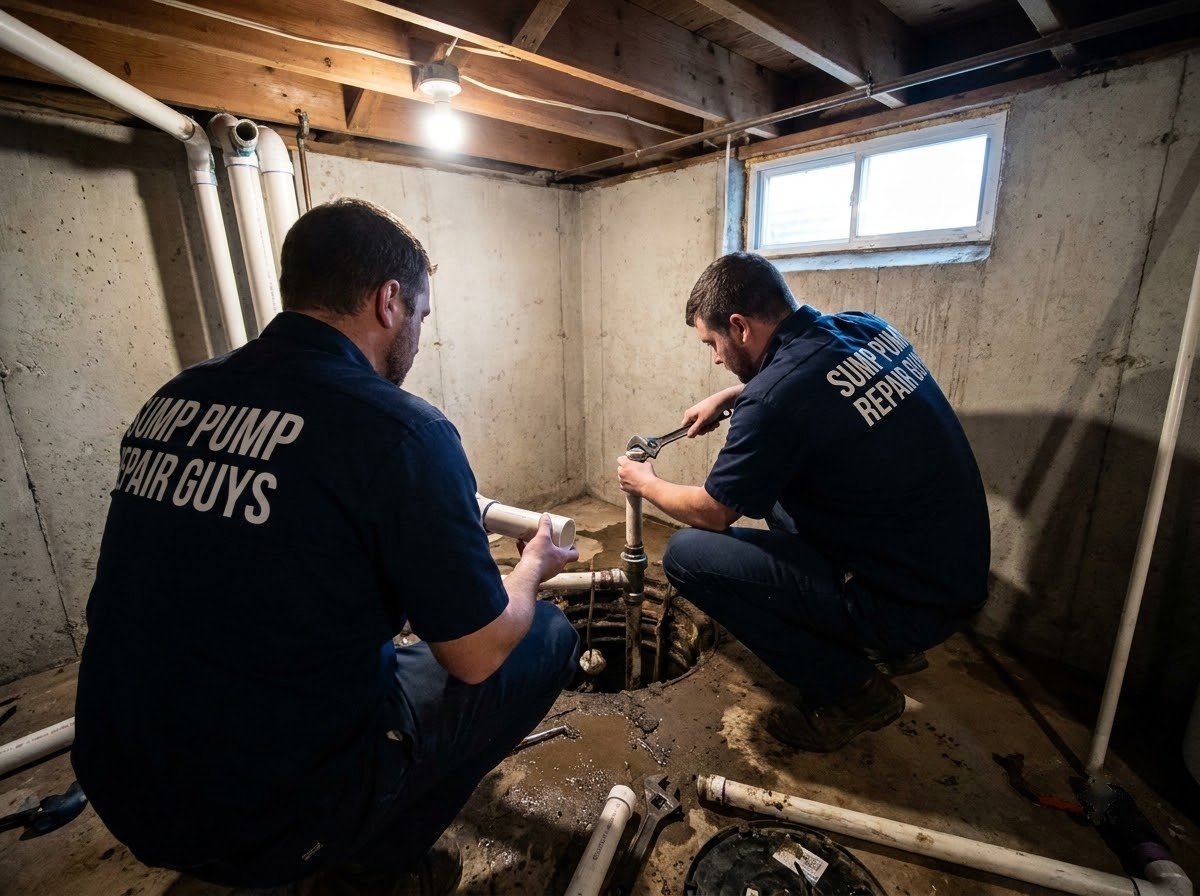
About Sump Pump Repair Guys in Gahanna
We repair sump pumps and nothing else. In Gahanna that focus is useful because the geography here is genuinely distinctive, and because the city has published a clear line about where its responsibility stops.
The name Gahanna is said to come from a Native American word meaning three creeks joining into one, and it was also the older name for Big Walnut Creek. Big Walnut, Rocky Fork and Sycamore Creek converge in and around this city. Converging watercourses mean converging water tables, and the corridors near them behave differently in wet weather from ground half a mile away.
Something else shaped drainage here, and it was a choice rather than an accident. Many Central Ohio communities built right up to the edge of the bigger streams and piped the smaller ones. Gahanna did not. During development planning the city engineers and the developers’ engineers studied the ravines where sewers were often planned, and both routinely committed to preserving them.
On the utility side, Gahanna is classified as a satellite community because it does not treat its own wastewater. Drinking water is provided by the City of Columbus and wastewater is sent to Columbus for treatment, while Gahanna remains responsible for all capital improvements to its own water, sanitary sewer and stormwater infrastructure.
The ownership line is stated plainly. The city maintains the sanitary mains. The property owner maintains the sanitary lateral, which runs from the main to the building. Almost every argument about a backup comes down to which side of that point the obstruction sits on.
- Big Walnut, Rocky Fork and Sycamore, which is where the city’s name is said to come from.
- City and developer engineers routinely committed to keeping the ravines rather than piping the smaller streams.
- The city maintains the sanitary mains; the property owner maintains the lateral running from the main to the building.
- You approve the number first. No surprise line items when the invoice arrives.
- We fill the pit and watch a full cycle: activation, run, shutoff, and any backflow through the valve.
Three creeks converge here
The ravines were preserved on purpose
City mains, your lateral
Priced before we start
Tested before we leave
Sump pump repair services in Gahanna
Sump pump repairs we handle in Gahanna
Most Gahanna sump pump problems are component faults. We work on the whole system so the repair holds: the pit, the switch, the valve, the motor and the line that carries the water away.
- 01
Sump pump diagnostics
A manual lift test separates a switch failure from a motor failure in under a minute. We identify the exact fault and its price before quoting anything, so you are not paying replacement rates for a parts-level problem.
- 02
Creek corridor assessment
The Gahanna-specific one. Proximity to Big Walnut, Rocky Fork or Sycamore changes how high the water table sits and how long it stays there, which changes what a pump is actually being asked to do.
- 03
Float switch repair and adjustment
The most common failure point on any pump. We free jammed floats, replace failed switches, and set trip heights so the on and off points do not overlap and start the pump short-cycling.
- 04
Check valve replacement
A failed valve lets the discharge column fall straight back into the pit, refilling it seconds after shutoff. It is a small part with a large effect on how hard your pump has to work.
- 05
Motor repair
Humming with no flow, tripped thermal overloads, failing bearings. We test the motor under load and tell you honestly whether a repair is worth it or whether the unit has been shortened past the point of value.
- 06
Impeller repair
Grinding and rattling usually mean debris in the vortex impeller or clearances worn open by grit. We open the unit, clear the obstruction and check whether the wear has already cost the pump its output.
- 07
Sump pit cleaning
Silt and iron ochre settle in the basin, block the intake screen and grind through the switch. Near the creek corridors a pit that runs often collects fines faster than one that rarely fills.
- 08
Pit and basin repair
Cracked or improperly seated basins let soil and silt in continuously, and undersized basins short-cycle every pump that goes into them regardless of quality.
- 09
Discharge line repair and rerouting
Blocked, crushed, or terminating where the water returns to your own footing. On a sloping ravine lot the routing options are different, and usually better, than on flat ground.
- 10
Frozen discharge line repair
A badly pitched line ices solid in a central Ohio January. We thaw and clear it, then correct the pitch and termination so it drains fully between cycles.
- 11
Backup system service
Storms take the power out at the exact moment the pump is needed most. We load test the battery, service the backup pump and confirm the changeover actually triggers.
- 12
Emergency service
Water already on the floor, alarm sounding, pump silent. Same day and after hours response across Gahanna. We get the system back in service first and have the longer conversation afterwards.
Why Gahanna homeowners call us first
Near converging creeks the same rainfall does very different things on different streets. Anyone quoting without asking where you sit is guessing.
-
We ask where you sit in the watershed
Creek corridor, ravine slope or upland flat. Three different water table behaviours, three different answers, and the question takes a few seconds.
-
We fix the cause, not the symptom
A new pump dropped into an undersized pit with a failed valve dies the same way the last one did. We correct the fault around the pump so the repair survives the next wet spring.
-
Answered at 2am
Pumps fail during storms, at night, and while you are away. Our lines stay open all night and all weekend, and someone picks up. Basements do not flood during business hours.
-
Priced before we start
You get a written number after the diagnosis and approve it before any work begins. No surprise line items when the invoice arrives.
-
Licensed and insured
Every technician who enters your home is properly licensed, insured and background checked. You can ask for the paperwork at the door.
-
We stand behind it
If the same fault comes back after we have worked on it, we come back and sort it out.
When to call a sump pump technician in Gahanna
Most of these are parts-level repairs. Two of them start with a call to the city, and one is a connection that should not exist at all.
-
01
Silent pump, rising pit
Call now
Check the breaker and the plug first, then lift the float by hand. If it runs, the switch is the fault and not the motor. Near a creek corridor the basin refills steadily, so this one does not wait until morning.
-
02
Sewer odour or a suspected backup
City first
The city asks to be called for either. A utility crew is dispatched to investigate and assess. If the obstruction is in the sanitary main they clear it. If it is in your lateral, clearing it becomes your responsibility, and at least you now know which.
-
03
High water alarm sounding
Call now
Inflow has overtaken output, which means something upstream already failed: the switch, the valve, the discharge line or the pump. The alarm is the last warning before water reaches the floor.
-
04
A house drain that runs to the storm system
The city names this among the illicit discharges it looks for: a home or workplace drain connected to the storm sewer instead of the sanitary sewer. Storm sewers do not lead to a treatment plant, so anything in them reaches a creek untreated.
-
05
Running non-stop in dry weather
Usually a float stuck raised or a failed check valve dropping the discharge column back into the pit. Near the creeks, occasionally a genuinely high water table. The first two are parts-level fixes.
-
06
Cycling on and off every few seconds
Short-cycling, usually from a basin too small for the inflow, a failed check valve, or float trip points set so close they overlap. A bigger pump makes this worse rather than better.
-
07
Humming with no water moving
Jammed impeller, seized bearings, or a completely blocked or frozen discharge line. Switch it off now. Clearing the impeller or the line is often a same-visit fix, but another hour of humming turns it into a replacement.
-
08
The problem lasts for days after the creek peaks
Surface flooding recedes with the creek. A high water table takes far longer to fall. If your basement stays wet well after the water has gone down outside, that is a groundwater pattern and a pump question rather than a river one.
-
09
Mature trees along your lateral
Established Gahanna streets carry a lot of canopy, and roots find clay pipe joints. A slow drain in dry weather is the early version of a backup in a storm, and it is far cheaper at that stage.
How a Gahanna service call runs
Five steps, the same every time. No sales visit, no waiting days for a number.
- 1
Place you in the watershed
Creek corridor, ravine or upland, and whether the water is surface, groundwater or sanitary. That framing decides everything that follows.
- 2
Check the setup
Pit, pump, float switch, check valve and discharge line, plus basin volume against real inflow and where the discharge actually terminates.
- 3
Test under water
We fill the basin and watch a real cycle: activation height, run, shutoff, and whether anything comes back through the valve.
- 4
Price it, then repair
Written number before anything is touched. If the obstruction belongs in the sanitary main rather than in your equipment, we say so and point you at the city.
- 5
Test again and hand it over
Final full-cycle test, then we show you how to check it yourself and what to watch for before the next wet season.
Ravines, satellites and storm drains
What makes Gahanna’s water different
Three converging creeks, a deliberate decision about ravines, and a city that sends its wastewater somewhere else. Each one shapes what happens in a basement here.
-
The name
Three creeks joining into one
That is what the name Gahanna is said to mean, and it was also the older name for Big Walnut Creek. Big Walnut, Rocky Fork and Sycamore all run through this area, which is a great deal of converging water for one city.
-
The decision
The ravines were kept, not piped
Many Central Ohio communities built to the edge of the bigger streams and piped the smaller ones. During development planning here, city and developer engineers studied the ravines where sewers were often planned, and both routinely committed to preserving them.
-
Why it mattered
Piped streams came back as flooding
The result of piping small streams elsewhere in Central Ohio has been flooding and sewage overflowing into rivers during heavy rain, at a correction cost running into hundreds of millions. Open ravines carry water the way it was always going to travel.
-
The utility
A satellite community
Gahanna is classified as a satellite community because it does not treat its own wastewater. Drinking water comes from the City of Columbus and wastewater is sent there for treatment, while Gahanna remains responsible for all capital improvements to its own infrastructure.
-
The obligation
A CMOM programme, by order
Ohio EPA has ordered all satellite communities operating a wastewater collection system to implement a capacity management, operations and maintenance programme, to manage collection system assets and ensure compliance with best management practices.
-
The storm side
Straight to the creeks, untreated
Unlike sanitary sewers, the storm system does not lead to a wastewater treatment plant. It carries stormwater directly and without treatment to local waterways, which is why only rainwater and snowmelt should ever go down a storm drain.
Gahanna neighborhoods we cover
Gahanna is shaped by its creeks and the ravines that were kept open around them. Properties in the corridors sit closest to a water table that rises and falls with the streams. Upland streets behave more like ordinary clay-soil drainage, where grading and discharge routing decide the outcome.
- Creekside
- Olde Gahanna
- Granville Street
- Hamilton Road
- Havens Corners
- Stygler Road
- Agler Road
- Morse Road
- Big Walnut Creek
- Rocky Fork
- Sycamore Creek
- Hunters Ridge
- Hannah Farms
- Royal Manor
- Academy Park
- Clark Hall
- Mifflin Township
- Jefferson Township
- New Albany
- Blacklick
- Westerville
- Whitehall
ZIP codes we service in Gahanna
Same-day coverage across Gahanna and the surrounding Franklin County communities.
- 43230
- 43004
- 43219
- 43054
- 43081
- 43082
- 43068
- 43229
- 43231
- 43213
- 43232
- 43110
- 43085
- 43240
- 43021
- 43062
Not listed? We cover all of Franklin County. Call and we will confirm in under a minute.
Gahanna sump pump questions, answered
The things Gahanna homeowners ask us most often, answered properly instead of with a sales line. If yours is not here, give us a call and we will talk it through.
Who do I call about a sewer backup?
The city. If you smell a sewer odour or suspect a backup, contact the Department of Public Service, Utility Billing Division. There is a weekday daytime number and a separate number for after 5pm, weekends and holidays.
A utility crew is then dispatched to investigate and assess. If the obstruction is in the sanitary main, the crew clears it. If it is in the sanitary lateral, clearing it is the property owner’s responsibility.
Where does the city’s responsibility end?
At the main. The city maintains the sanitary mains, and the property owner maintains the sanitary lateral, which runs from the main to the building.
That line is why the city’s investigation matters so much. It establishes which side the obstruction is on before anyone starts paying for excavation or jetting.
What is a satellite community?
One that collects wastewater but does not treat it. Gahanna is classified that way because drinking water is provided by the City of Columbus and wastewater is sent to Columbus for treatment.
Gahanna still owns and is responsible for all capital improvements to its water, sanitary sewer and stormwater infrastructure. The pipes are local even though the treatment is not.
What is a CMOM programme?
Capacity management, operations and maintenance. Ohio EPA has ordered all satellite communities operating a wastewater collection system to implement one, in order to manage collection system assets and ensure compliance with best management practices.
For a homeowner it means the collection system is under a formal maintenance regime rather than being fixed only when something fails, which is generally good news for anyone at the end of an old lateral.
Why does living near a creek matter so much?
Because the creek and the water table move together. When Big Walnut, Rocky Fork or Sycamore run high after sustained rain, the groundwater in the surrounding corridor rises with them and stays up longer than the surface water does.
A pump in that situation is doing legitimate work rather than misbehaving. The question is whether it is sized and routed for how many hours a year it actually has to run.
Why did Gahanna keep its ravines?
It was a deliberate planning choice. During development, city engineers and the developers’ engineers studied the ravines where sewers were often planned, and both routinely committed to preserving them rather than filling or piping them.
Elsewhere in Central Ohio, communities built to the edge of the bigger streams and piped the smaller ones, and the result has been flooding and sewage overflowing into rivers during heavy rain, with correction costs running to hundreds of millions.
Can I put my sump discharge into a storm drain?
Clean groundwater is what storm drains are for, but the rules matter and it is worth confirming for your property. What is never acceptable is anything other than rainwater or snowmelt, because the storm system does not lead to a treatment plant.
It carries stormwater directly and without treatment to local waterways, which here means the creeks the city is named after. A home drain connected to the storm system instead of the sanitary sewer is specifically listed as an illicit discharge.
My basement stays wet for days after the creek drops. Why?
Because you are dealing with groundwater rather than surface water. Surface flooding recedes as the creek recedes. A saturated water table drains far more slowly, especially through the clay-heavy soil across this part of Franklin County.
That distinction matters for the fix. Surface water needs barriers and grading. Groundwater needs a working pit, a properly sized pump and a discharge that puts the water somewhere it cannot return from.
Do I need a bigger pump if mine cannot keep up?
Usually not. A pump that cannot keep up is often fighting a failed check valve, a blocked or frozen discharge line, a basin too small for the inflow, or water arriving by a route the pump does not serve at all.
Oversizing into a small pit is actively harmful: the pump empties the basin faster than it refills, short-cycles, and destroys its own switch. Sizing should follow pit volume, total lift and measured inflow.
How do I test my sump pump myself?
Pour several gallons of water slowly into the basin and watch a full cycle. The float should rise, the pump should start, the water should clear, and the pump should shut off on its own.
Then keep watching for thirty seconds. Water flowing back into the pit means the check valve is failing. If the pump does not start at all, lift the float by hand: if it runs then, the switch is the problem, not the motor. Test in autumn before the freeze and again in early spring.
Which Gahanna areas and ZIP codes do you cover?
All of Gahanna and the surrounding Franklin County communities, including Creekside, Olde Gahanna, Havens Corners, Hunters Ridge, Hannah Farms, Royal Manor, Academy Park and Clark Hall, plus the Granville Street, Hamilton Road, Stygler Road, Agler Road and Morse Road corridors, the Big Walnut, Rocky Fork and Sycamore Creek areas, Mifflin and Jefferson townships, New Albany, Blacklick, Westerville and Whitehall.
ZIP codes include 43230, 43004, 43219, 43054, 43081, 43082, 43068, 43229, 43231, 43213, 43232, 43110, 43085, 43240, 43021 and 43062.
How quickly can someone come out?
Same day across most of Franklin County, and after hours for emergencies where water is already coming in. Diagnosis takes thirty to sixty minutes, and a parts-level repair such as a float switch or check valve is generally completed in the same visit.
Sustained rain is the exception, when the creek corridors call at once. An inspection booked in dry weather is worth far more than a place in that queue.
Three creeks converge. Your basement should not.
Emergency repair, water source diagnosis, pit and valve testing, or a full-system inspection in dry weather. Serving Gahanna and all of Franklin County.