
24/7 Emergency Service in Butler County
Sump Pump Repair in Hamilton, OH
Levees Handle the River. Your Pump Handles Everything Else.
Hamilton has five miles of levee and a hard-won reputation for flood control. None of that touches the groundwater under your floor, and one stretch of levee here is not flood protection at all.
Answered 24 hours. Free quote over the phone.
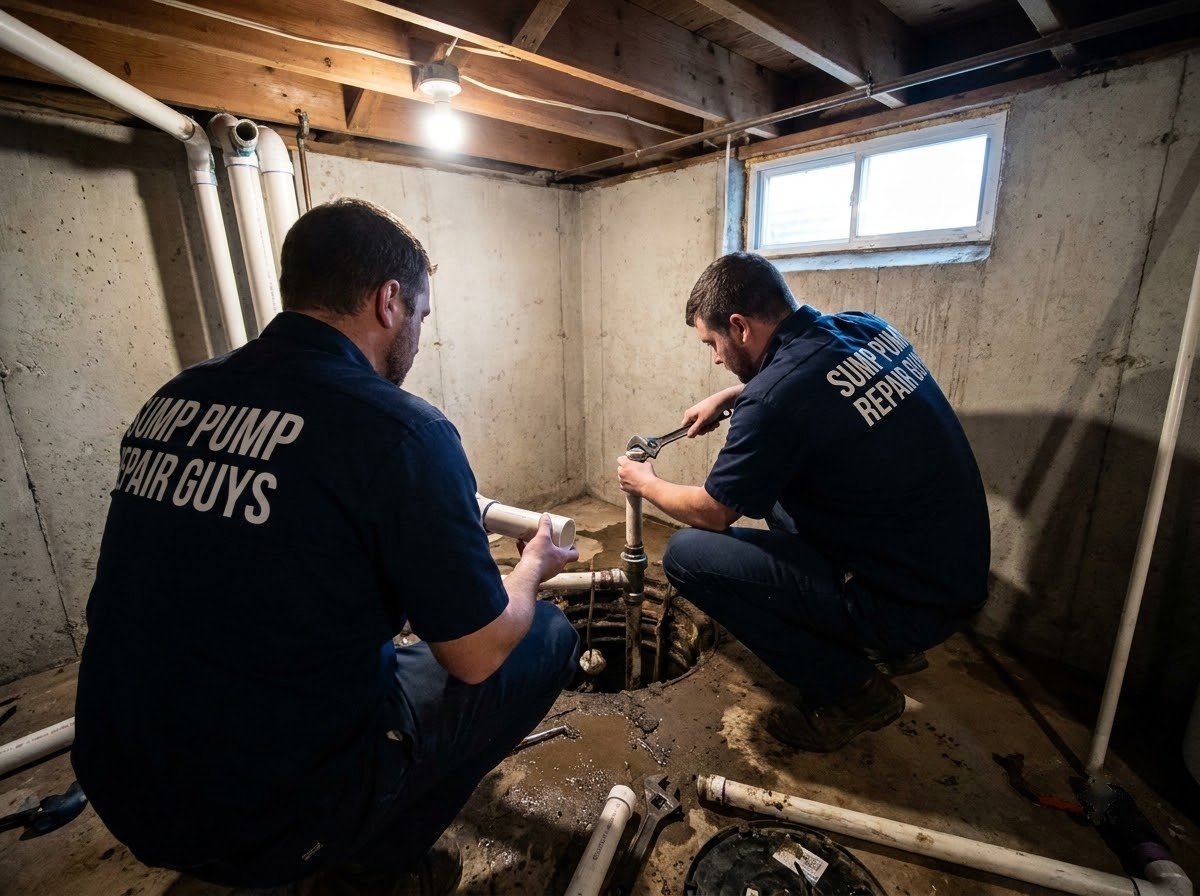
About Sump Pump Repair Guys in Hamilton
We repair sump pumps and nothing else. In Hamilton that focus leads straight to a distinction most homeowners here have never had explained to them: the difference between being protected from the river and being protected from the water table.
Hamilton earned its flood infrastructure the hard way. On 25 March 1913 the Great Miami River took more than 200 lives in this city, left around 10,000 people homeless, destroyed some 300 buildings and forced the demolition of roughly 2,000 more. All four bridges were gone within hours. Survivors helped create the Miami Conservancy District, and today MCD maintains 5.1 miles of levee and 3.8 miles of improved channel here, with Hamilton sitting as the most downstream local protection feature on the system.
That system works. What it does not do is stop groundwater rising under your slab, and there is a specific local catch worth knowing. MCD states plainly that the right bank levee along the Sharon Park plat was built to channelize the river upstream of the low dam and does not provide flood protection to the neighbourhood. A levee near your house is not automatically a levee protecting your house.
Underneath all of it sits the same buried valley aquifer that runs the length of this watershed, made of permeable sand and gravel that takes water down quickly and holds a responsive water table close to the surface. The city occupies both banks of the river, and Two Mile Creek and the Hamilton Hydraulic both discharge into it at the north end. There is a great deal of water moving around this town at all times.
So on a Hamilton call the first question is which water you are dealing with, because flood zone status answers only one of the two.
- Plus 3.8 miles of improved channel maintained by the Miami Conservancy District at Hamilton, the most downstream local protection feature.
- MCD states the right bank levee along the Sharon Park plat was built to channelize the river and does not provide flood protection to that neighbourhood.
- The buried valley aquifer under this watershed is sand and gravel, so water moves down easily and the water table responds fast.
- You approve the number first. No surprise line items when the invoice arrives.
- We fill the pit and watch a full cycle: activation, run, shutoff, and any backflow through the valve.
5.1 miles of levee
One levee is not protection
Permeable ground beneath
Priced before we start
Tested before we leave
Sump pump repair services in Hamilton
Sump pump repairs we handle in Hamilton
On permeable valley ground the pump runs often, and the wear parts go first. We work on the whole system: the pit, the switch, the valve, the motor and the line that carries the water away.
- 01
Sump pump diagnostics
A manual lift test separates a switch failure from a motor failure in under a minute. We identify the exact fault and its price before quoting anything, so you are not paying replacement rates for a parts-level problem.
- 02
Duty cycle assessment
On a responsive water table, frequent running can be correct behaviour. We measure how often your pump actually runs against what your pit size and inflow justify, so you know whether it is a fault or the ground.
- 03
Float switch repair and adjustment
The first casualty of a high duty cycle, because every cycle is a mechanical operation. We free jammed floats, replace failed switches, and set the trip differential properly.
- 04
Check valve replacement
A failed valve lets the discharge column fall straight back into the pit, adding cycles to a pump that already runs hard. Cheap part, and it adds years to the pump above it.
- 05
Motor repair
Humming with no flow, tripped thermal overloads, failing bearings. We test the motor under load and tell you honestly whether a repair is worth it or whether the unit has been shortened past the point of value.
- 06
Impeller repair
Grinding and rattling usually mean debris in the vortex impeller or clearances worn open. Sand and fine gravel are exactly what this valley sits on, and exactly what ends up in your basin.
- 07
Sump pit cleaning
Sand infiltration is heavier on permeable ground than in clay soil towns. Sediment grinds mechanical switches, jams impellers and narrows float travel until the switch stops working reliably.
- 08
Pit and basin sizing
Hamilton’s older housing frequently has pits cut in decades after construction. An undersized basin under a responsive water table is a short-cycling machine that destroys whatever pump you put in it.
- 09
Discharge line repair and rerouting
On permeable ground, water discharged near the house percolates straight back down to the pit. We move the termination point far enough out that you are not pumping the same water twice.
- 10
Frozen discharge line repair
An iced line leaves the pump running against a closed pipe until the thermal cutout trips. We thaw, clear, then correct the pitch so it drains fully between cycles.
- 11
Backup system service
Deep cycle batteries lose capacity quietly over three to five years and fail during the outage they were bought for. We load test the battery, service the backup pump and confirm the changeover triggers.
- 12
Emergency service
Water already on the floor, alarm sounding, pump silent. Same day and after hours response across Hamilton. We get the system back in service first and have the longer conversation afterwards.
Why Hamilton homeowners call us first
Most companies competing for this work in Hamilton are full-service plumbers and waterproofing contractors. Sump pumps are one line on a long list, and the bigger job is always the more profitable one.
-
We will tell you the pump is fine
On a responsive valley water table a pump that runs often is frequently healthy. Saying so costs us a sale and saves you several hundred dollars, which is exactly why a company that only does pumps can afford to say it.
-
We know what the levees do and do not cover
Flood protection status is about the river. It says nothing about the water table under your slab, and in at least one part of this city a levee is not flood protection at all. That distinction changes what you should be spending money on.
-
Answered at 2am
Pumps fail during storms, at night, and while you are away. Our lines stay open all night and all weekend, and someone picks up. Basements do not flood during business hours.
-
Priced before we start
You get a written number after the diagnosis and approve it before any work begins. No surprise line items when the invoice arrives.
-
Licensed and insured
Every technician who enters your home is properly licensed, insured and background checked. You can ask for the paperwork at the door.
-
We stand behind it
If the same fault comes back after we have worked on it, we come back and sort it out.
When to call a sump pump technician in Hamilton
On this ground, frequent running is normal and constant running is not. Knowing where that line sits is most of the diagnosis.
-
01
Silent pump, rising pit
Call now
Check the breaker and the plug first, then lift the float by hand. If it runs, the switch is the fault and not the motor. On permeable valley ground the basin refills quickly, so this one does not wait until morning.
-
02
High water alarm sounding
Call now
Inflow has overtaken output, which means something upstream already failed: the switch, the valve, the discharge line or the pump. The alarm is the last warning before water reaches the floor, and silencing it buys you nothing.
-
03
It runs every few minutes, even in dry weather
This is the Hamilton question. Steady cycling with a genuinely high water table can be correct. What is not correct is cycling within seconds rather than minutes, running with the pit visibly empty, or a clear increase over what the same pump did last year.
-
04
You assumed the levee covers you
Worth checking rather than assuming. MCD is explicit that the right bank levee along the Sharon Park plat was built to channelize the river and does not provide flood protection to that neighbourhood. Proximity to a levee is not the same as being behind one that protects you.
-
05
Cycling on and off within seconds
Short-cycling, and on a high water table it is brutal on equipment. Usually a failed check valve dropping the discharge column back in, a basin too small for the inflow, or float trip points set so close that the on and off heights overlap.
-
06
Humming with no water moving
Jammed impeller, seized bearings, or a completely blocked or frozen discharge line. Switch it off now. Clearing the impeller or the line is often a same-visit fix, but another hour of humming turns it into a replacement.
-
07
Grit at the bottom of the pit
Sand and fine gravel are what this valley is made of, and they migrate into basins faster here than in clay ground. Grit wears out mechanical switches faster than anything else and opens up impeller clearances. A gritty pit is a countdown.
-
08
The pump is over five or six years old
Note that number. The usual advice is seven to ten years, but that assumes a pump idles between storms. A pump working a responsive valley water table reaches the same running hours sooner, so start watching it earlier than the label suggests.
-
09
Your backup has never been load tested
With groundwater this close to the surface, a pump offline for a few hours matters more than it would elsewhere. A battery that tested fine two seasons ago may have almost nothing left. If you have never load tested yours, you do not currently know whether you have a backup.
How a Hamilton service call runs
Five steps, the same every time. No sales visit, no waiting days for a number.
- 1
Measure the duty cycle
Before anything else we watch how often the pump runs and how long it rests. On this valley ground that single measurement tells us whether we are looking at a fault or at normal groundwater.
- 2
Check the setup
Pit, pump, float switch, check valve and discharge line, including basin volume against inflow and where the discharge actually terminates on permeable ground.
- 3
Test under water
We fill the basin and watch a real cycle: activation height, run, shutoff, and whether anything comes back through the valve.
- 4
Price it, then repair
Written number before anything is touched. If the honest answer is that your pump is healthy and doing its job, that is what you get told, and you pay for the inspection rather than a pump.
- 5
Test again and hand it over
Final full-cycle test, then we show you how to check it yourself and what a normal cycle count looks like for your house.
Hamilton flood protection, and its limits
What the levees cover and what they leave to you
Hamilton has one of the best flood control records in the country and paid for it in 1913. Understanding exactly what that system does is the difference between real confidence and false confidence.
-
1913
Why the system exists
On 25 March 1913 the Great Miami River took more than 200 lives in Hamilton, left roughly 10,000 people homeless and caused more than 10 million dollars in damage in the money of the day. Three of the four bridges were swept away within two hours and the fourth followed. Around 300 buildings were destroyed and about 2,000 more had to be razed.
-
The response
Citizens funded the fix themselves
Survivors helped create the Miami Conservancy District, and some 23,000 citizens across the valley contributed more than two million dollars of their own money toward a valley-wide flood protection programme. It remains an unusual piece of civic history, and the system built from it is still in service.
-
Today
5.1 miles of levee at Hamilton
MCD maintains 5.1 miles of levee and 3.8 miles of improved channel here. Hamilton is the most downstream local protection feature on the system, and the city occupies both banks of the river with the central business district on the east side.
-
The exception
Sharon Park is not protected by its levee
This is the detail worth knowing. MCD states that the right bank levee along the Sharon Park plat was built to channelize the river upstream from the low dam and does not provide flood protection to the neighbourhood. If you live near it and have assumed otherwise, that assumption is worth correcting.
-
Local water
The river is not the only channel here
Two Mile Creek and the Hamilton Hydraulic both discharge into the Great Miami at the north end of the protection feature. Local drainage, creek behaviour and street runoff are separate matters from the main river, and they reach basements by their own routes.
-
Underneath
Groundwater is a different problem entirely
Levees and dry dams manage surface water in the river channel. They do nothing about the buried valley aquifer beneath the town, which is permeable sand and gravel with a water table that responds quickly to rainfall. A house can be fully protected from the Great Miami and still run a sump pump most of the year.
Areas we cover in Hamilton
Elevation has always decided this town. In 1913 the Sixth ward at Lindenwald was untouched and East Hamilton escaped the worst, while the First ward closest to the river was devastated. The same relative heights still shape which basements sit closest to the water table today.
- Downtown Hamilton
- Rossville
- German Village
- Dayton Lane
- Prospect Hill
- Lindenwald
- East Hamilton
- Highland Park
- Sharon Park
- Two Mile
- Fairfield
- New Miami
- Seven Mile
- Trenton
- Middletown
- Monroe
- Oxford
- Ross
- Millville
- West Chester
- Liberty Township
- Franklin
ZIP codes we service in Hamilton
Same-day coverage across Hamilton and the surrounding Butler County communities.
Not listed? We cover all of Butler County. Call and we will confirm in under a minute.
Hamilton sump pump questions, answered
The things Butler County homeowners ask us most often, answered properly instead of with a sales line. If yours is not here, give us a call and we will talk it through.
I am behind a levee. Why do I still need a sump pump?
Because levees and dry dams manage water in the river channel, not water in the ground. The Miami Conservancy District maintains 5.1 miles of levee and 3.8 miles of improved channel at Hamilton, and that system does its job. It has nothing to do with the buried valley aquifer beneath your basement.
There is also a specific local caveat. MCD states that the right bank levee along the Sharon Park plat was built to channelize the river upstream of the low dam and does not provide flood protection to that neighbourhood. Being near a levee is not the same as being protected by one.
My pump runs every few minutes. Is it broken?
Possibly not. Hamilton sits on the buried valley aquifer, which is permeable sand and gravel rather than clay. Water moves down through it easily, so the water table is both high and quick to respond after rain. Regular cycling can be the system working correctly.
Three things do indicate a fault: cycling within seconds rather than minutes, running with the pit visibly empty, or a clear increase over what the same pump did last year. Any of those is worth a call. Steady, spaced cycling with a full pit usually is not.
How long should a sump pump last in Hamilton?
Less than the seven to ten years quoted everywhere else, because that figure assumes long idle periods between storms. A pump on a high duty cycle accumulates the same running hours in noticeably less calendar time.
Start paying attention at five or six years here. The switch usually goes first, since every cycle is a mechanical operation and a pump on this ground performs a great many more of them.
Do I need a bigger pump if mine cannot keep up?
Usually not. A pump that cannot keep up is often fighting a failed check valve, a partly blocked discharge line, or a basin too small for the inflow. None of those improve with more horsepower.
Oversizing into a small pit is actively harmful, because the pump empties the basin faster than it refills, short-cycles and destroys its own switch. On a responsive water table that damage accumulates quickly. Sizing should follow pit volume, total lift and measured inflow.
Where should my discharge line end?
Further from the house than you think. On permeable sand and gravel, water released near the foundation soaks straight back down and returns to the pit, so you end up pumping the same water repeatedly and paying for the cycles.
The discharge also must not be directed onto a neighbouring property or into the public right-of-way. Getting the distance and direction right once lowers your duty cycle permanently.
I keep finding sand and grit in my pit. Is that normal here?
More normal than in clay ground, because the aquifer under this valley is literally sand and gravel and fines migrate into the basin over time. Normal does not mean harmless.
Grit is the fastest way to wear out a mechanical float switch, it jams vortex impellers, and it opens up clearances so the pump moves less water than its rating. Annual pit cleaning is worth more here than most maintenance advice suggests.
Does the 1913 flood still matter to my house?
Directly, no. Indirectly, a great deal. That event killed more than 200 people in Hamilton and led citizens across the valley to fund the Miami Conservancy District themselves, which is why the flood protection you rely on exists at all.
It also left a useful map. The wards nearest the river took the worst of it while higher ground at Lindenwald was untouched. Those relative elevations still describe which parts of town sit closest to the water table today.
How do I test my sump pump myself?
Pour several gallons of water slowly into the basin and watch a full cycle. The float should rise, the pump should start, the water should clear, and the pump should shut off on its own.
Then keep watching for thirty seconds. Water flowing back into the pit means the check valve is failing. If the pump does not start at all, lift the float by hand: if it runs then, the switch is the problem, not the motor. Also note roughly how many times it cycles in an hour, because that number is your baseline.
Should I repair or replace?
Replace when the repair estimate reaches about half the cost of a new unit installed, or when the pump is past its useful life. In Hamilton read that age threshold down rather than up, because running hours accumulate faster here.
A three or four year old cast iron pump with a worn float switch is worth repairing. An eight year old thermoplastic pump on a high duty cycle with a seized impeller is not.
Does homeowners insurance cover a flooded basement in Hamilton?
Usually not by default. Standard policies generally exclude groundwater intrusion and flooding caused by sump pump failure, and coverage for that event is sold as a separate rider or endorsement.
Flood insurance is a separate matter again and addresses river risk rather than groundwater. Being outside a flood zone tells you about the Great Miami. It tells you nothing about what your pump is dealing with.
Which Hamilton areas and ZIP codes do you cover?
All of Hamilton and the surrounding Butler County area, including Downtown, Rossville, German Village, Dayton Lane, Prospect Hill, Lindenwald, East Hamilton, Highland Park, Sharon Park and Two Mile, plus Fairfield, New Miami, Seven Mile, Trenton, Middletown, Monroe, Oxford, Ross, Millville, West Chester, Liberty Township and Franklin.
ZIP codes include 45011, 45013, 45014, 45015, 45012, 45044, 45042, 45050, 45069, 45067, 45056, 45005, 45003, 45004, 45053 and 45061.
How quickly can someone come out?
Same day across most of Butler County, and after hours for emergencies where water is already coming in. Diagnosis takes thirty to sixty minutes, and a parts-level repair such as a float switch or check valve is generally completed in the same visit.
Heavy storm events are the exception, when calls across the county spike within the same hours. An inspection booked outside those periods is worth far more than a place in that queue.
The levees handle the river. Let us check what handles the rest.
Duty cycle assessment, emergency repair, discharge correction, or a full-system inspection. Serving Hamilton and all of Butler County.