
24/7 Emergency Service in Cuyahoga County
Sump Pump Repair in Westlake, OH
No River To Blame Here
Westlake has almost no surface water within its boundaries. That means a wet basement here is about the ground, the grading or the pipe, and nothing else.
Answered 24 hours. Free quote over the phone.
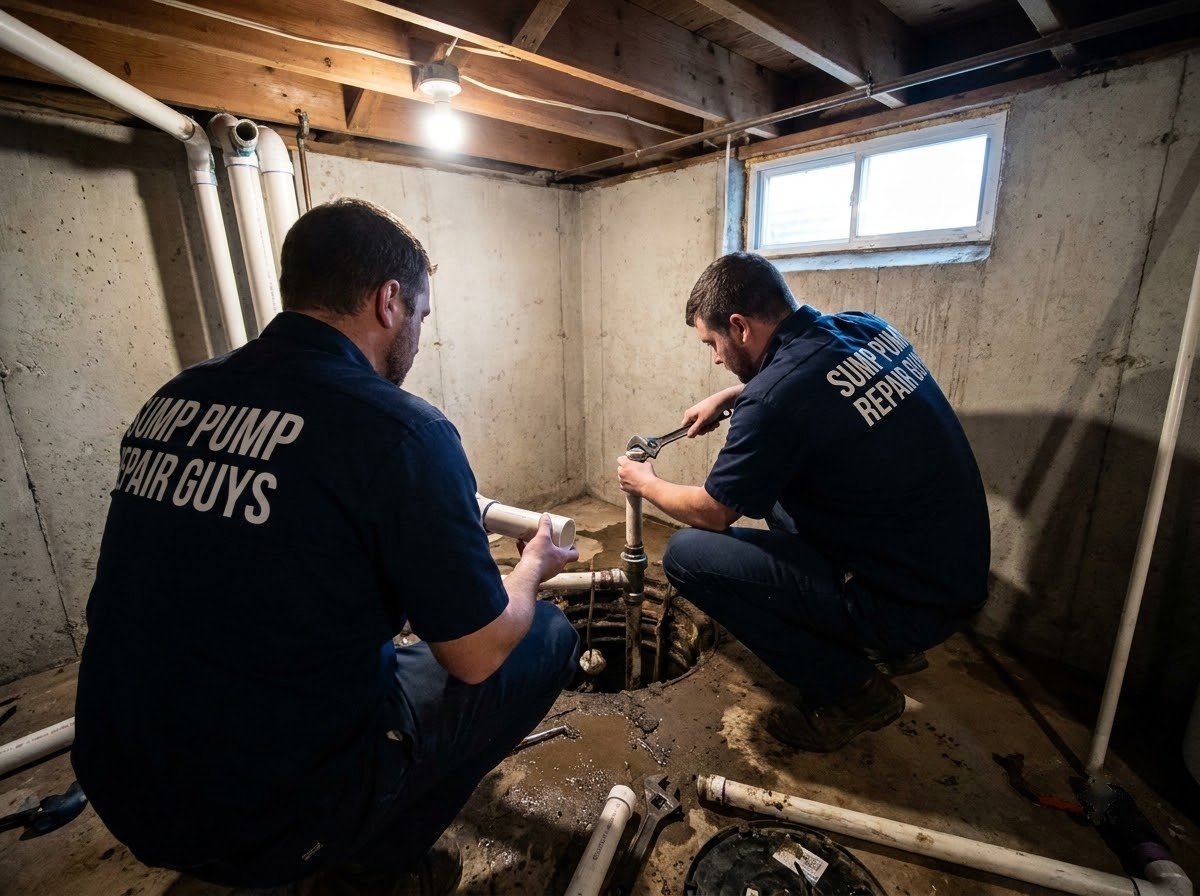
About Sump Pump Repair Guys in Westlake
We repair sump pumps and nothing else. In Westlake that focus is useful because this city removes one of the easiest excuses in the trade, and what is left is a much more honest diagnosis.
Westlake covers about 15.9 square miles, and essentially none of it is water. There is no river running through town and no lake shore. When a basement takes water in Lakewood people point at the lake, and in Kent they point at the Cuyahoga. Here there is nothing to point at except the ground under the house and the pipes around it.
The city sits at roughly 709 feet, well above Lake Erie, on the high ground back from the shore. That elevation helps, but it does not make clay drain any faster. Rain that lands on a Westlake lot has to soak in or be carried away, and where it does neither it collects against a foundation.
The utility arrangement is worth knowing too. The city bills the sewer utility directly, while the water bill comes from Cleveland Water. So one organisation charges you for what arrives and a different one for what leaves, and they are not the same phone call.
Westlake became a city in 1957, and much of the housing stock followed in the decades after. Post-war suburban construction on Cuyahoga County clay produces a fairly predictable set of problems, and a fairly predictable set of fixes.
- Roughly 15.9 square miles of land and effectively none of it water, so there is no river or lake shore to blame.
- The sewer utility bill comes from Westlake, while the water bill comes from Cleveland Water.
- Much of the housing stock dates from the decades that followed, on clay-heavy county soil.
- You approve the number first. No surprise line items when the invoice arrives.
- We fill the pit and watch a full cycle: activation, run, shutoff, and any backflow through the valve.
Almost no surface water
Sewer is the city, water is Cleveland
A city since 1957
Priced before we start
Tested before we leave
Sump pump repair services in Westlake
Sump pump repairs we handle in Westlake
Most Westlake sump pump problems are component faults. We work on the whole system so the repair holds: the pit, the switch, the valve, the motor and the line that carries the water away.
- 01
Sump pump diagnostics
A manual lift test separates a switch failure from a motor failure in under a minute. We identify the exact fault and its price before quoting anything, so you are not paying replacement rates for a parts-level problem.
- 02
Lot drainage review
The Westlake specific one. With no watercourse to carry blame, the answer is almost always in how water moves across your own lot and where the discharge and downspouts put it.
- 03
Float switch repair and adjustment
The most common failure point on any pump. We free jammed floats, replace failed switches, and set trip heights so the on and off points do not overlap and start the pump short-cycling.
- 04
Check valve replacement
A failed valve lets the discharge column fall straight back into the pit, refilling it seconds after shutoff. It is a small part with a large effect on how hard your pump has to work.
- 05
Motor repair
Humming with no flow, tripped thermal overloads, failing bearings. We test the motor under load and tell you honestly whether a repair is worth it or whether the unit has been shortened past the point of value.
- 06
Impeller repair
Grinding and rattling usually mean debris in the vortex impeller or clearances worn open by grit. We open the unit, clear the obstruction and check whether the wear has already cost the pump its output.
- 07
Sump pit cleaning
Silt and iron ochre settle in the basin, block the intake screen and grind through the switch. On Cuyahoga County clay with original footer drains, fines accumulate steadily.
- 08
Pit and basin repair
Cracked or improperly seated basins let soil and silt in continuously, and undersized basins short-cycle every pump that goes into them regardless of quality.
- 09
Discharge line repair and rerouting
Blocked, crushed, or terminating where the water returns to your own footing. On a flat suburban lot the routing decides almost everything, because gravity offers very little help.
- 10
Frozen discharge line repair
Lake effect winters ice a badly pitched line solid. We thaw and clear it, then correct the pitch and termination so it drains fully between cycles instead of freezing again next month.
- 11
Backup system service
Storms take the power out at the exact moment the pump is needed most. We load test the battery, service the backup pump and confirm the changeover actually triggers.
- 12
Emergency service
Water already on the floor, alarm sounding, pump silent. Same day and after hours response across Westlake. We get the system back in service first and have the longer conversation afterwards.
Why Westlake homeowners call us first
Without a river to blame, the diagnosis has to be honest. That suits us, because guessing is what makes repairs come back.
-
We walk the lot before the basement
On flat ground with no watercourse nearby, where the water goes across your own property explains most of what happens under it.
-
We fix the cause, not the symptom
A new pump dropped into an undersized pit with a failed valve dies the same way the last one did. We correct the fault around the pump so the repair survives a lakeside winter and the melt after it.
-
Answered at 2am
Pumps fail during storms, at night, and while you are away. Our lines stay open all night and all weekend, and someone picks up. Basements do not flood during business hours.
-
Priced before we start
You get a written number after the diagnosis and approve it before any work begins. No surprise line items when the invoice arrives.
-
Licensed and insured
Every technician who enters your home is properly licensed, insured and background checked. You can ask for the paperwork at the door.
-
We stand behind it
If the same fault comes back after we have worked on it, we come back and sort it out.
When to call a sump pump technician in Westlake
Most of these are parts-level repairs. Several are outside faults rather than basement faults, which is what you would expect in a city with no watercourse doing the damage.
-
01
Silent pump, rising pit
Call now
Check the breaker and the plug first, then lift the float by hand. If it runs, the switch is the fault and not the motor. On heavy clay the basin refills steadily, so this one does not wait until morning.
-
02
Sewage backing up through a drain
City first
No pump serves this. The city runs the sewer utility here, so that is the call to make before hiring anyone, and it establishes whether the fault is in the public main or your own lateral.
-
03
High water alarm sounding
Call now
Inflow has overtaken output, which means something upstream already failed: the switch, the valve, the discharge line or the pump. The alarm is the last warning before water reaches the floor.
-
04
Water pooling in the same spot after every storm
On flat ground a low spot never drains, it just waits. A puddle that reappears in the same place is telling you exactly where the grading needs correcting, and it is usually cheaper than any equipment.
-
05
Downspouts ending beside the wall
A roof delivers an enormous volume very quickly. Dropping it a foot from the foundation sends it straight down to the footer drains, into the pit, and back out through a pump you are paying to run.
-
06
Running non-stop in dry weather
Usually a float stuck raised or a failed check valve dropping the discharge column back into the pit. The first two are parts-level fixes and cost a fraction of a replacement.
-
07
Cycling on and off every few seconds
Short-cycling, usually from a basin too small for the inflow, a failed check valve, or float trip points set so close they overlap. A bigger pump makes this worse rather than better.
-
08
Humming with no water moving
Jammed impeller, seized bearings, or a completely blocked or frozen discharge line. Switch it off now. Clearing the impeller or the line is often a same-visit fix, but another hour of humming turns it into a replacement.
-
09
Trouble arrives with the melt, not the storm
Lake effect snowfall loads the ground faster than it can drain, and clay holds it. If your basement problem is a February or March problem, that is your real risk window and autumn is when to prepare for it.
How a Westlake service call runs
Five steps, the same every time. No sales visit, no waiting days for a number.
- 1
Start outside
Grading, low spots, downspout terminations and where the discharge ends. On flat suburban lots this is where most of the answer lives.
- 2
Check the setup
Pit, pump, float switch, check valve and discharge line, plus basin volume against real inflow and how far the line actually carries the water.
- 3
Test under water
We fill the basin and watch a real cycle: activation height, run, shutoff, and whether anything comes back through the valve.
- 4
Price it, then repair
Written number before anything is touched. If the fix is fifteen feet of downspout extension rather than a pump, we say so and you pay nothing for it.
- 5
Test again and hand it over
Final full-cycle test, then we show you how to check it yourself and what to watch for before the next thaw.
A city with nothing to blame
What actually causes wet basements in Westlake
Take away the river and the lake shore, and the list of real causes gets short, specific and mostly fixable. That is good news, even if it sounds less dramatic.
-
The geography
Fifteen square miles, almost no water
Westlake covers about 15.9 square miles and effectively none of it is surface water. There is no river through town and no lake frontage, which removes the two causes homeowners elsewhere reach for first.
-
The elevation
High ground, slow soil
At roughly 709 feet the city sits well above the lake, back from the shore on the higher ground. Elevation protects against flooding from a watercourse. It does nothing at all about clay that will not accept rain quickly.
-
Cause one
Grading that has settled
Soil placed against a foundation at construction settles over decades until the fall reverses. Once the ground tips back toward the wall, every storm is delivered to the footing rather than away from it.
-
Cause two
Roof water landing at the wall
Downspouts terminating within a few feet of the foundation put hundreds of gallons into the exact place you least want it. Extending them properly is among the cheapest interventions available on any property.
-
Cause three
Discharge that comes straight back
On a flat lot a short discharge line simply recycles the same water. The pump empties the pit, the water soaks down to the footer drains, and the pit refills. Owners conclude the pump is undersized when the routing was the problem.
-
Cause four
Equipment nobody has tested
Float switches, check valves and pit condition account for the majority of the failures we attend. All three are cheap to check in dry weather and expensive to discover during a February thaw.
Westlake neighborhoods we cover
Westlake spreads across gently rolling high ground west of Cleveland, with the older Dover Center area at its core and decades of subdivision growth around it. Lots are generous and gradients are gentle, which makes discharge routing and downspout placement matter more here than terrain ever does.
- Dover Center
- Crocker Park
- Center Ridge Road
- Detroit Road
- Hilliard Boulevard
- Bradley Road
- Columbia Road
- Clague Road
- Bassett Road
- Canterbury Road
- Crocker Road
- Clague Park
- Porter Creek area
- Cahoon Creek area
- Bay Village
- Rocky River
- Fairview Park
- North Olmsted
- Avon
- Avon Lake
- North Ridgeville
- Lakewood
ZIP codes we service in Westlake
Same-day coverage across Westlake and the surrounding Cuyahoga and Lorain County communities.
- 44145
- 44140
- 44116
- 44107
- 44070
- 44126
- 44012
- 44011
- 44039
- 44017
- 44130
- 44133
- 44136
- 44149
- 44035
- 44102
Not listed? We cover all of Cuyahoga County. Call and we will confirm in under a minute.
Westlake sump pump questions, answered
The things Westlake homeowners ask us most often, answered properly instead of with a sales line. If yours is not here, give us a call and we will talk it through.
Why does my basement take water when there is no river nearby?
Because most basement water has nothing to do with rivers. Westlake has effectively no surface water within its boundaries, and yet pumps here run hard, because the water that matters is the rain landing on your own lot.
Clay soil accepts rain slowly. What it cannot absorb travels along the surface or down the backfill beside the foundation, which is looser than the undisturbed ground around it. That path leads straight to the footer drains and the pit.
Who do I call about sewer and water?
Two different places. The sewer utility is billed by the city, so sewer questions and sanitary backups go to Westlake. The water bill comes from Cleveland Water, which handles water service.
Knowing which is which saves a phone call at a bad moment. Sewage backing up through a floor drain is a city matter. A supply problem is Cleveland Water’s.
What is the cheapest thing that actually works?
Downspout extensions, followed by correcting the grade. A roof sheds an enormous volume very quickly, and delivering that within a few feet of the wall undoes everything else you might spend money on.
Both are measured in feet of pipe and hours of work rather than thousands of dollars, and on a flat lot they frequently remove the problem entirely.
How far should my discharge line run?
Far enough that the water cannot return, which on level ground is further than most people assume. A short line simply recycles the same water: the pump empties the pit, the water soaks back down to the footer drains, and the pit refills.
The pump then runs constantly and fails years early, and the owner concludes it was undersized. It usually was not. It was moving the same water in a circle.
Does high elevation protect me?
From flooding by a watercourse, yes. Westlake sits at roughly 709 feet, well above the lake and away from any river, so the kind of flooding that reaches homes in a valley is not the risk here.
It offers no protection at all against the water table beside your foundation after sustained rain, or against a failed check valve. Those are the two things that actually put water on floors in this city.
Why is late winter worse than summer?
Because lake effect snow loads the ground faster than it can drain, and clay does not accept water quickly. When a thaw arrives, that water moves toward the lowest point available rather than soaking away.
It is why so many failures cluster in February and March. A tired pump gets through an entire year and then meets one significant melt event with a switch that was already marginal.
Do I need a bigger pump if mine cannot keep up?
Usually not. A pump that cannot keep up is often fighting a failed check valve, a blocked or frozen discharge line, a basin too small for the inflow, or water arriving by a route the pump does not serve at all.
Oversizing into a small pit is actively harmful: the pump empties the basin faster than it refills, short-cycles, and destroys its own switch. Sizing should follow pit volume, total lift and measured inflow.
Should I repair or replace?
Replace when the pump is past seven to ten years old, or when the repair estimate reaches about half the cost of a new unit installed. Below that line, repair usually wins.
In much of Westlake’s post-war housing the pump is the newest part of the system while the pit and the footer drains are original. Replacing the pump alone leaves everything around it unchanged, which is why the same problem returns.
Do I need a backup pump?
It is worth having anywhere the power goes out during storms, which is most of Northeast Ohio. The storms that most need a pump are precisely the ones that cut the electricity to it.
The important part is testing it. An untested backup is not a backup, and a battery showing a healthy voltage can still collapse under load the moment the pump actually asks anything of it.
How do I test my sump pump myself?
Pour several gallons of water slowly into the basin and watch a full cycle. The float should rise, the pump should start, the water should clear, and the pump should shut off on its own.
Then keep watching for thirty seconds. Water flowing back into the pit means the check valve is failing. If the pump does not start at all, lift the float by hand: if it runs then, the switch is the problem, not the motor. Test in autumn before the freeze and again in late February.
Which Westlake areas and ZIP codes do you cover?
All of Westlake and the surrounding Cuyahoga and Lorain County communities, including Dover Center, Crocker Park, Clague Park and the Center Ridge Road, Detroit Road, Hilliard Boulevard, Bradley Road, Columbia Road, Clague Road, Bassett Road, Canterbury Road and Crocker Road corridors, plus the Porter Creek and Cahoon Creek areas, Bay Village, Rocky River, Fairview Park, North Olmsted, Avon, Avon Lake, North Ridgeville and Lakewood.
ZIP codes include 44145, 44140, 44116, 44107, 44070, 44126, 44012, 44011, 44039, 44017, 44130, 44133, 44136, 44149, 44035 and 44102.
How quickly can someone come out?
Same day across most of Cuyahoga County, and after hours for emergencies where water is already coming in. Diagnosis takes thirty to sixty minutes, and a parts-level repair such as a float switch or check valve is generally completed in the same visit.
Melt events are the exception, when calls across the west side spike within the same hours. An inspection booked in autumn is worth far more than a place in that queue.
No river to blame. Just the ground and the pipes.
Emergency repair, water source diagnosis, pit and valve testing, or a full-system inspection before the melt. Serving Westlake and all of Cuyahoga County.